Social Associations

Strong and supportive social networks help residents to be resilient during difficult times. Social associations are a useful proxy for social capital, networks of relationships and trust among people in a community. Social capital is a particularly important resource for people living in multidimensional poverty who have limited access to many other resources. Social connections can help those in poverty find solutions for the problems they face obtaining transportation, child care, and housing.

Peer City Perspective

Louisville currently ranks 14th among its peer cities with approximately 10 associations per 10,000 residents.

Louisville is in the bottom tier of its peer group according to a natural breaks algorithm. Cities in green are those that outperform their peers, cities in yellow represent the middle cluster, and those in red are a group that lags behind its peers on this indicator.

Trends Over Time

The rate of social associations relative to the population in Louisville was steadily decreasing from 2000 to 2011 but has remained relatively constant between 2011 and 2017. This decreasing trend is similar to the overall trend observed in Louisville’s peer cities, although Louisville has fallen below the 25th percentile of its peers.

Comparison between the Most and Least Improved Peer Cities

Since 2000, Grand Rapids saw its number of membership organizations remain constant, while the number of membership associations in Greensboro decreased greatly.

Racial Geography

In order to achieve a prosperous community in which all residents can participate fully, high levels of segregation in communities should be reduced. Although complete desegregation is not necessarily a desirable outcome due to the destruction of social capital built from within communities, fostering cultural exchange and horizontal relationships will yield greater economic and social prosperity, and ultimately stronger communities.

While there are many facets of diversity that one could study when considering segregation, race is most commonly associated with the practice of segregation. The present effects of a history of segregation across geographic and racial lines damage a community’s quality of life and stunt the development of community-wide prosperity and cultural exchange.

Peer City Perspective

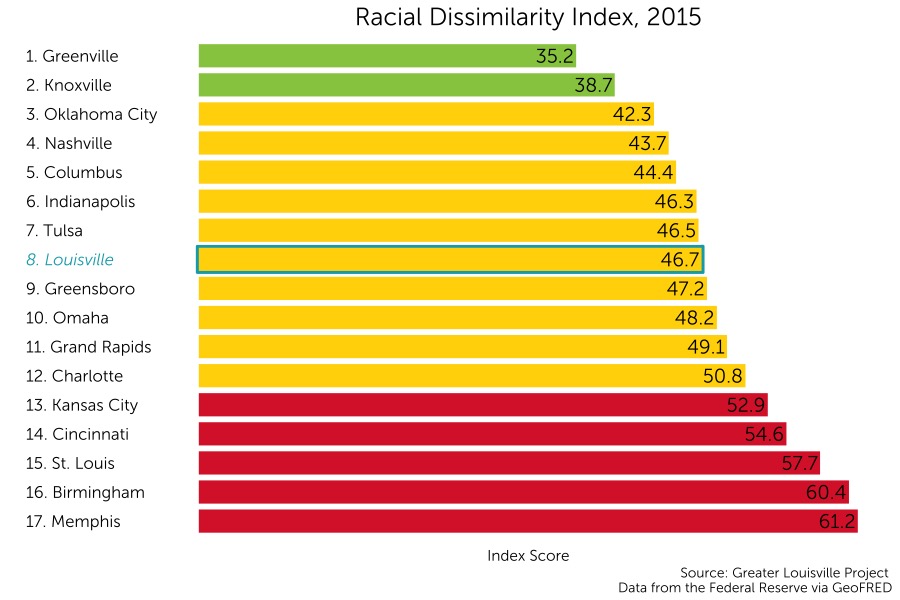
Louisville currently ranks 8th among its peers in the index of dissimilarity when considering white and non-white residents. The index of dissimilarity can be interpreted as the percentage of residents in a given city that would be required to move to a new census tract in order to achieve the citywide ratio of white to non-white residents in each census tract, creating greater opportunity for cross-cultural exchange and horizontal relationship building. Higher index values indicate higher levels of segregation.

Louisville ranks among the middle of its peer group according to a natural breaks algorithm. Cities in green are those that outperform their peers, cities in yellow represent the middle cluster, and those in red are a group that lags behind its peers on this indicator.

Where are Minority Residents Concentrated?

Louisville’s minority residents are highly concentrated in the West End and in the Buechel neighborhoods. The percentage of white residents is as low as 0.3% in one tract of Algonquin. The St. Matthews and Southeast Louisville neighborhoods have the highest percentages of white residents.

Scroll over the map to see values for each census tract. Zoom in to see street names that form the boundaries of each tract.

Trends Over Time

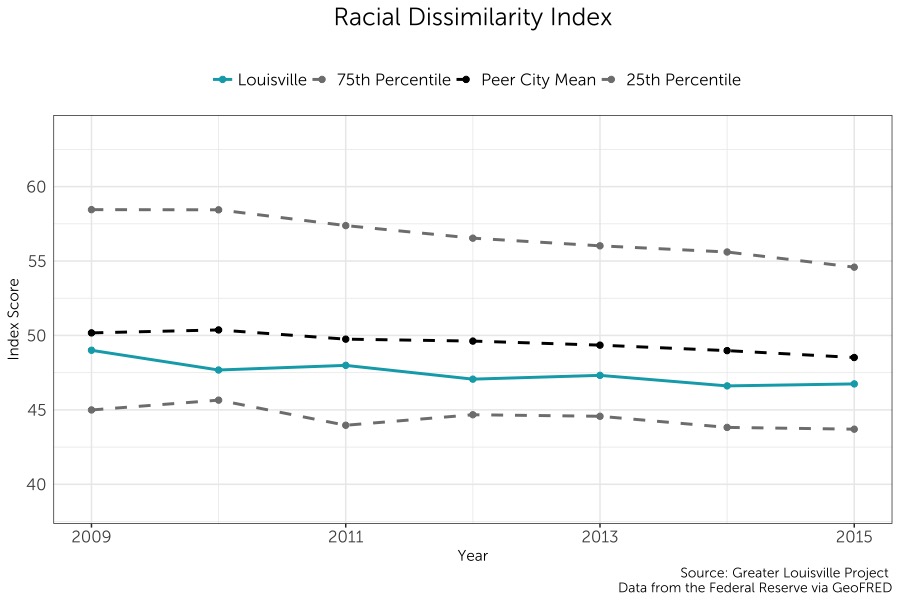
The Index of dissimilarity has decreased slowly from 2009 to 2015 in Louisville, suggesting that the city has experienced low-rates of integration since 2009. Louisville has consistently had a lower index score than the average of its peers.

Continue Exploring with Related Data

Food Deserts

Social Associations

Unemployment

Volunteerism

Volunteering builds social capital which leads to stronger, more resilient communities. In addition to satisfaction for the volunteer, individuals who volunteer can help solve community-wide problems and build relationships. Additionally, volunteering has been linked to health benefits such as lower mortality rates and improved mental health.

Peer City Perspective

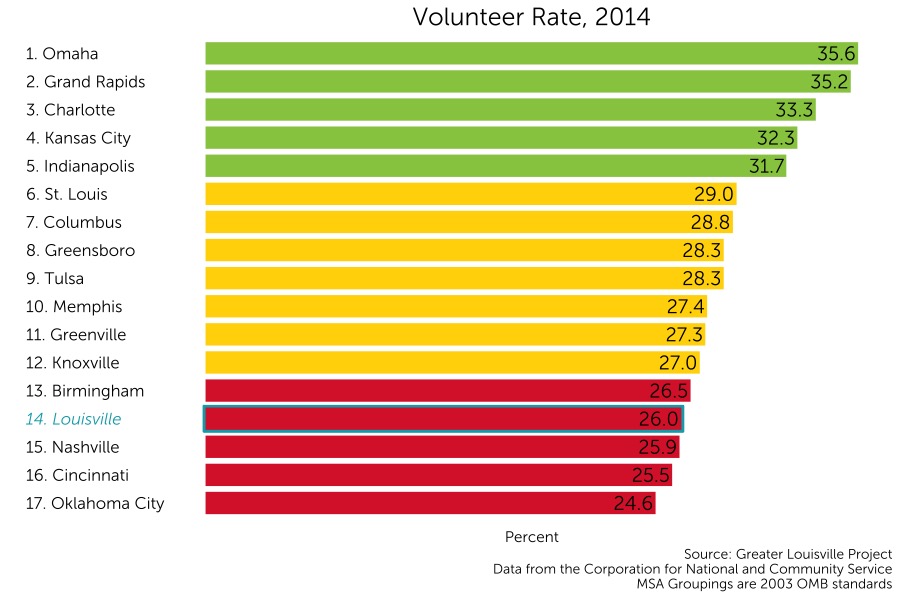
Louisville currently ranks 14th among its peers in volunteerism with a rate of 26%. The volunteer rate is calculated from American Community Survey data asking respondents if they have volunteered at least once in the past year.

On this metric, Louisville ranks among the bottom tier of its peer cities according to a natural breaks algorithm. Cities in green are those that outperform their peers, cities in yellow represent the middle cluster, and those in red are a group that lags behind its peers on this indicator.

Trends Over Time

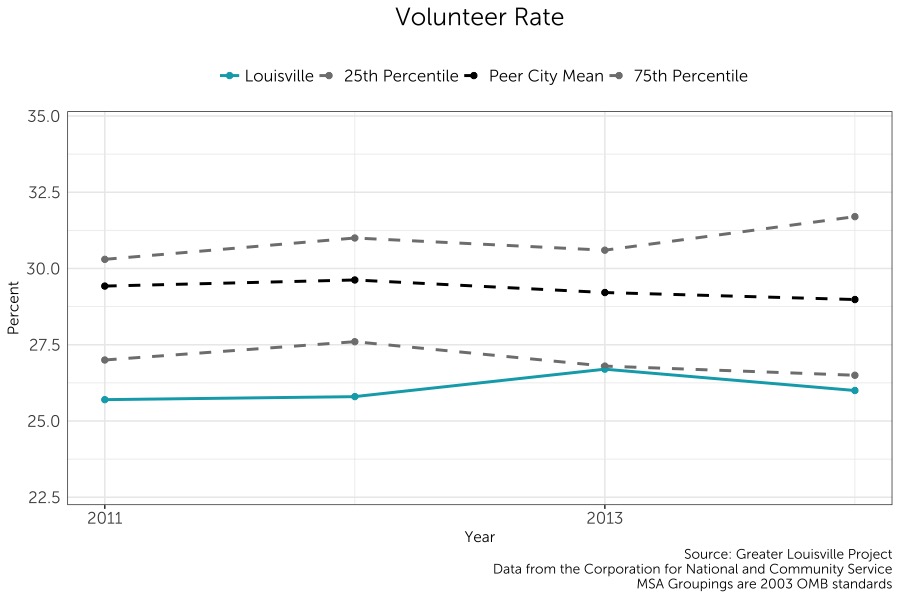
Louisville’s rate of volunteerism has slowly increased from 2011 to 2014. However, Louisville’s volunteerism rate is still below the 75th percentile of its peers.